Copyright © 2003-2011, Aishah Schwartz. Permission granted to circulate among private individuals, groups, or in not-for-profit publications in full text and subject title. All other rights reserved.

January 23, 2007

BOOK REVIEW: Living Islam Out Loud: American Muslim Women Speak

edited by Saleemah Abdul-Ghafur

Written by David Barker
Published January 22, 2007

PURCHASE ONLINE HERE

Living Islam Out Loud is one of the best non–fiction works I have read in a long time. It is a collection of pieces by Islamic women living in the United States. Their stories reflect a diversity of experience — from growing up within the tradition–laden strictures of immigrant families, to Afro–American women who are children and grandchildren of Nation of Islam founders. A common theme beneath these accounts is the hyphenated nature of existence for Islamic women living in a predominantly secular/Christian culture.

When I was a child growing up within Ontario's public education system, I was exposed — like thousands of others my age — to a social studies curriculum that betrayed more than a small hint of anxiety about the Canadian identity question. How were we to resist the looming presence of American culture creeping up from the south? One answer, as a matter of educational policy, was to teach us that there were differences, however subtle. One difference was the American melting–pot/Canadian mosaic distinction. Both countries are peopled predominantly by immigrants imposed on dwindling native populations. When immigrants come to America, there is a tacit expectation that they will blend in, dress in jeans, eat at McDonald's, watch Hollywood movies, and (of course) learn to speak English. But in Canada, perhaps because of Québec's presence as a constitutionally protected "distinct society," there is less pressure — at least officially — for newcomers to blend in. We belong to a mosaic. The hyphen is essential to our identity. And so we are Indian–Canadian, Euro–Canadian, Chinese–Canadian, and so on.

Sometimes I'm skeptical whether there is any truth to the official indoctrination we received as children. However, at least conceptually, we understand what it means to have a hyphenated identity, and, at least conceptually, we have little problem with the idea that a person might want to assert the part they have brought with them from their homeland. And so the voices I encounter within Living Islam Out Loud strike me as more assertive than necessary. Then I remember: I am not an American reader.

One of the boldest pieces within the collection is "The Muslim in the Mirror," by Mohja Kahf, and it perfectly illustrates the demand to be acknowledged as distinctive, She writes: "If there's anyone I was more sick and tired of than Muslims, it's Muslim–bashers. No one is allowed to criticize Islam and Muslims but those who do it from love. Those who do it from hate, step aside. And step aside, those who do it as a way to fame and fortune funded by neo–conservatives who think they can kaCHING up genuine "reform" in Islam and manufacture docile little McMuslims for the maintenance of U.S. McHegemony in the world. Neocons can kiss my Islamic ass.

"Not exactly the writing we expect from our stereotypical woman of Islam, demure in her hijab! But that is one of the points of the book — with women claiming identity from so many different sources, there is no such thing as a stereotypical woman of Islam.

Perhaps it is increasingly difficult for people in the U.S. to maintain the story of America as a cultural melting pot. I think of Ada Maria Isasi—Diaz, author of En la Lucha (In the Struggle): A Hispanic Women's Liberation Theology, who writes of mujerista theology among Hispanic women in America. There is a growing trend among Hispanic women to expect not only their faith, but also their social services, including education and health care, to happen on their terms, to be delivered in Spanish, and to be sensitive to the particularity of their culture and history as a distinctive people. What may strike some Americans as uppity (or even as bordering on treasonous) is a 350–year–old fact of life on Canadian soil — and no one seems to be worse for it. In fact, the converse may be true. It may be that we find ourselves enriched for allowing those we encounter to live on their own terms. Could America be moving in the same direction?

However, it would be misleading to suggest that the women contributing to this collection are primarily engaged in struggles against a hegemonic American culture bent upon pouring them into Barbie molds. For many of the contributors — certainly all those born to immigrants — the greatest points of tension arise from within Islam. The question of hijab is the least of their worries. Or perhaps, by its many different understandings, it reflects the complexity of life for women. For some, wearing hijab is an attempt at earnest devotion, for others, a bold assertion of identity, for still others, a great way to deal with a bad hair day, but for many, it represents views of sexuality whose unhealthiness has intensified once transplanted to American soil. Surprisingly (for a Westerner like me), if there is oppression of women, few of these writers find it in Islam itself. Like the Bible, the Qu'ran can be interpreted to support all sorts of nastiness, but these women read it in ways which affirm them. Instead, most oppression in their experience arises from an insecure foothold in a strange new land.

So, for example, Samina Ali tells how she came with her family to Minneapolis from Hyderabad, India. When she married, she had to be a virgin. If not, she would be useless to her husband and would bring dishonour to her family. Along with her Islamic friends (making lasting friendships with Americans was out of the question), she was married off to a young man from India.

"Our parents plucked these men out of their homelands for this very reason: the daughter's purity should match her groom's, a man not exposed to and perhaps even controlled in some invisible way by demonic Western possession. In this manner, the daughters of the community became mere vessels of parental legacy.

"Utterly naive, Samina Ali blamed herself when, after the wedding, her husband refused to touch her and was repulsed by her body to the point of vomiting. She was convinced that she must have done something wrong. Even after he confessed that he was gay and left her, she continued to believe that her own faithlessness was to blame for the failed marriage. Family and friends disbelieved her story and assumed she was slandering her husband. Her husband could not possibly be gay; she was merely failing in her duties as a wife. What followed was the difficult work to establish a sense of herself apart from family and faith, before re–entering her faith with a more mature understanding.

But we must be careful not to presume too much sexual oppression. "A Day In The Life," a poem by Su'ad Abdul–Khabeer, makes it clear that if we use Western mores as our yardstick, we may find ourselves on questionable ground:

"And their mani–pedi
consorts
talk smack,
frontin'
like they kick it
with freedom on the regular
their angular
sentiments
under the guise
of liberty.
Free yourself!
they tell me,
patting my hand
tugging my scarf,
From the tyranny of Faith —
So ...I can be neatly chained
to a thong?"

Another struggle from within Islam arises from the segregationist practices of many mosques, which require women to use separate entrances and to pray behind a curtain or wall. In 1994, only one-third of American mosques had instituted this practice, but by 2000, the number had risen to two-thirds. In "Being the Leader I Want to See in the World," Asra Q. Nomani tells how, despite feelings of inadequacy, she found herself inevitably challenging the practices of her mosque in Morgantown, WV. It began as personal indignation, and grew into a national media event that brought about change and resulted in "An Islamic Bill of Rights for Women in Mosques" and "An Islamic Bill of Rights for Women in the Bedroom."

Although this book is about gender and identity and asserting power over one's own destiny, all these themes get rolled into a larger theme — this is a book about spirituality. It isn't surprising, given that Abdul–Ghafur serves on the Board of Directors of the Progressive Muslim Union, that her book includes several progressive contributions. So, for example, Mohja Kahf concludes her piece with two wonderful paragraphs that seem to rise out of Islam resonate across the faiths. They begin with:

"...I began to free myself of the false god who lived within, the god whose obsession is obedience. I had been battered by an internalized idea of this god. My prior clumsy attempts to make my way around him by myself gave me that crazy schizoid feeling — that I must be doing something terribly wrong in going outside the house of tradition, disobeying, while a yaqin–certainty told me that not to do so violated everything I knew to be sacred.

"And near the end, Inas Younis offers "My Son The Mystic," which grounds some of the most profound reflections on the nature of spirit in the experience of dealing with an autistic child. Her reflection runs in two directions. Looking one way, she asks: how could it be wrong for her to make room for ego when it was the absence of ego which lay at the heart of her son's disease? And looking in the opposite direction: was there not something strangely holy about her son who lived permanently in a state that only the holiest of Sufi mystics ever knows? While the challenge which Younis must confront differs considerably from the challenges of the other contributors, she follows their path insofar as she rejects a simplistic understanding of Islam and moves to a more mature engagement with her faith. Perhaps that is all any of us, whatever our faith, can or even should aspire to.

Theoblogger - a forty-something ex-lawyer theologian from Toronto dedicated to finding the nuggets beneath the mountains of crap that some try to pass off as belief.

January 15, 2007

From a Muslim Outlook, Imams Have Missed the Point on Flight Behavior

By M. Zuhdi Jasser
Dec. 11, 2006

The first thing one must understand about this whole hullabaloo with the Muslim imams taken off a Phoenix-bound plane in Minneapolis is that it most definitely was not about the right to prayer or freedom of worship.

And much as the imams and their handlers may try, it is certainly not about victimization.

But because the case of the six imams (five from the Valley) and US Airways Flight 300 has taken on a life of its own, it would be helpful to look and see what lessons can be gleaned from this story.

All of us as Americans have endured the incremental inconveniences of air travel since 9/11. From 3-ounce fluid limits to random searches, those of us with the first name Mohammed can also attest to humbling profiling. Most of us are quite willing to endure all this because we know the inherent dangers of flying in the world today.

There is little argument that American airport concourses have become clinics of anxiety-laden travelers who have become vigilant in spotting anything out of the ordinary. This vigilance and anxiety is even more acutely felt by U.S. Transportation Security Administration agents and airline crews. They will never be rewarded for a safe flight. But they will be globally vilified for one lax call that leads to tragedy.

Into this highly charged environment comes this incident of the imams returning from their conference. To ignore the larger context is to virtually live in an airtight bubble.

The preponderance of evidence points to some troubling coincidences during flight preparation, regardless of where we stand on this issue. The distribution of their seats, while in fact random, raised concern. Changing seats after boarding, rather than before, raised concern. Conversations in Arabic after boarding raised concern. Seatbelt extenders raised concern. However, no passengers refused to board after seeing and hearing the imams pray aloud at the gate. Taken individually, each of the reported actions could be something any of us would do. However, in totality, although unfortunate in retrospect, it remains hard to fault a cautious crew who must act with little information to ensure a safe flight.

But let us look at the response of the imams since the incident.

They rushed toward the media never looking back. They have taken their story of victimization to every soft media they could find. They then stoked the same tired Muslim flames of victimization through their own political pulpits in mosques around the Valley.

Organizations like CAIR (Council on American-Islamic Relations) and the Muslim American Society also immediately jumped on board, even before the imams' flight reached Phoenix the next day, and began whipping up the drums of victimization. Their handlers flew in from across the country staging rallies and pray-ins so they could teach the American people about this supposed tragedy of injustice.

As a devout Muslim, I have watched this painfully protracted saga unravel, fearing what comes next. The media, especially print media, have bent over backward to hear minorities' fears. Yet public opinion has not seemed to budge in favor of the imams. The lesson here lies in why. It has to do with credibility.

We are all creatures of passion. This fiasco has stirred the passionate cry of victimization from the Muslim activist community and imam community. But where were the news conferences, the rallies to protest the endless litany of atrocities performed by people who act supposedly in my religion's name? Where are the denunciations, not against terrorism in the abstract, but clear denunciations of al-Qaida or Hamas, of Wahhabism or militant Islamism, of Darfurian genocide or misogyny and honor killings, to name a few? There is no cry, there is no rage. At best, there is the most tepid of disclaimers. In short, there is no passion. But for victimization, always.

Only when Americans see that animating passion will they believe that we Muslims are totally against the fascists that have hijacked our religion. There is only so much bandwidth in the American culture to focus upon Islam and Muslims. If we fill it with our shouts of victimization, then the real problems from within and outside our faith community will never be heard.

Though this was not about prayer, let us look at the prayer itself: certainly a central part of our faith both alone and in congregation. The Quran teaches Muslims that God did not make our faith to be too difficult. Thus, during travel, many of us pray alone in silence when we cannot find a private place or where public display is not appropriate.

Prayer is an intimate thing, five times a day for Muslims. It is a personal conversation with God and not about showing others how devout we are.

Congregational prayers are preferred, but in travel (as three of the imams did apparently do) they can be combined upon their arrival in Phoenix.

Alija Izetbegovic, former president of Bosnia-Herzegovina, once said he was never so close to God in his prayers as a Muslim as he was during his solitary confinement for 12 years as a political prisoner struggling for liberty under Josip Broz Tito's oppression.

These imams would do well to learn from President Izetbegovic. He further understood the separation of religion and politics.

He understood God teaches us in the Quran that our religion is based upon intention and that if we perceive that the public situation is not conducive to our congregational prayer, that a forgiving God will understand.

Because these imams and their handlers just don't get it, it's time we Muslims found leadership and organizations that do.

Our predicament is unique, fragile and precarious. We Muslims are a relatively new minority in a nation that gives us freedoms that no other Muslim nation would allow.

Whether we acknowledge it or not, a radical subset of our faith community is seeking to destroy the basis for this liberty.

Either we predominantly direct our passions against these radicals or Americans will not count us as allies in this consuming struggle.

M. Zuhdi Jasser is a Phoenix physician and chairman of the American Islamic Forum for Democracy. He can be reached at
Zuhdi@aifdemocracy.org.

January 14, 2007

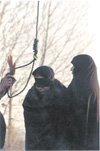
UPDATE 2: Nazanin Fatehi Acquitted!

Jan. 14, 2007 UPDATE 2 PRESS RELEASE For Immediate Release According to information received by the International Committee Against Execution, the charges against Nazanin Fatehi, the teenager under a sentence of death in Iran, have been dropped. She will probably be released from jail next week. Earlier today, the court sitting in Tehran decided on Nazanin’s case and told the defence lawyers that she would not have to face execution but has to pay financial compensation before she is released. The defence lawyers are planning to oppose the compensation ruling and are demanding that she be released immediately on bail. The Save Nazanin Campaign will follow Nazanin's case and keep the public and the press informed of her situation. The International Committee Against Execution congratulates all those who have helped and supported the campaign to save Nazanin's life. This is a victory for humanity and against ignorance and laws of retribution. Mina Ahadi Co-ordinator International Committee Against Execution http://maryamnamazie.blogspot.com/2007/01/nazanin-fatehi-acquitted.html

See Also: http://www.newswire.ca/en/releases/archive/January2007/15/c5930.html

UPDATE: Iranian girl who killed 'rapist' may be spared death penalty By Angus McDowall in Tehran Published: 14 January 2007 The case came back to court on Wednesday, when Ms Fatehi, now 19, was told by the judges that they did not consider the killing to be deliberate. Defence lawyers are confident she will be spared the death penalty, and expect a sentence within 10 days. Hopes have risen for an Iranian teenager sentenced to death for stabbing a would-be rapist, after a panel of Islamic judges declared on the first day of her retrial that she had not committed intentional murder. The case of Nazanin Fatehi, highlighted in The Independent on Sunday last week, has caused an international outcry. She was sentenced to be hanged a year ago, but a retrial was ordered by Ayatollah Mahmoud Shahroudi, head of Iran's religious judiciary, after an Iranian-born singer and former Miss Canada, Nazanin Afshin-Jam, gained more than 300,000 signatories to a petition. Nazanin Fatehi was 17 when she and her niece, 15, were attacked by three men in a park in Karaj, a town an hour's drive west of Tehran. She stabbed one of the men in the hand and another, who died, in the chest. A third man escaped unharmed. "I wanted to defend myself and my niece," she said at her first trial, when she appeared in court crying, wearing a prison-issue floral chador. "I did not want to kill that boy ... I did not know what to do, because no one came to help us." Ms Fatehi's defence team, led by the human rights lawyer Shadi Sadr, will make its case this week. Ms Sadr last year helped save Ashraf Kalhori, convicted of murdering her husband, from death by stoning. She also represented the family of Atefeh Rajabi, a 16-year-old girl hanged for "crimes against chastity" in 2004. The prosecutor and the dead man's family have requested the death penalty under qisas, a category of Islamic law that demands equal punishment for a crime. When the retrial opened, the dead man's family scuffled with Ms Fatehi's father, according to Iranian human rights websites.

January 11, 2007

Nazanin Fatehi...Not Forgotten...Sign the Petition TODAY!

In the Name of Allah, Most Gracious, Most Merciful [Taken from the Muslimah Writers Alliance Muslim Women Making History Project originally published last March and updated today.]
Jan 10, 2007: Nazanin Trial Update Sign Petition to Save Nazanin Fatehi
My signature number is 310747 - add yours today! Feminists Should Focus on Basic Rights for All [Excerpt] By Kathryn Lopez - Newspaper Enterprise Association March 6, 2006 Wednesday marks what the United Nations designates "International Women's Day." I'll be thinking about an 18-year-old Iranian girl named Nazanin that day. Instead of letting activists waste the day denouncing George W. Bush and other protectors of human rights and freedom, the United Nations ought to use its bullhorn to insist that Nazanin become a household name. Nazanin and her 16-year-old niece were about to be raped last year when the older girl stabbed two of their three attackers, killing one. Nazanin reportedly told a criminal court that "I wanted to defend myself and my niece. I did not want to kill that boy. At the heat of the moment I did not know what to do because no one came to our help." But she was sentenced to death earlier this year for her crime. Her (insane) sentence is subject to higher court review. International Women's Day this year should be Save Nazanin Day. It's not only this one young woman's life who might be saved, but also countless unknowns in similar situations. (read more) In Iran, violence against women has been legalised and institutionalised by the state. A recent study conducted by the National Welfare Organisation found that two-thirds of Iranian women are victims of domestic violence. Iran remains one of the only countries in the world where women are stoned to death. Last year, the UN Special Rapporteur for Violence Against Women, Professor Ertürk, chastised Iran over what she said were abuses and discrimination built into the Islamic republic's laws. She wrote in her report: "Iran's laws do not provide protection for victims of domestic violence and make it difficult to escape violence through divorce." (read more) On the web: Death sentence for a teenage girl in Iran condemned An 18-year-old girl to be hanged in Iran
http://mwawomenmakinghistory.blogspot.com/2006/03/nazaninnot-forgotten.html

January 07, 2007

Shop Turkey

Assalamu Alaikum wa Rahmatuallahi wa Barakatuhu. Insha'Allah this message finds you in the best of health and imaan. Amin.
It's been some time since I put a plug in for my good friend in Florida, Br. Rasim, who has a very nice business known as "
Shop Turkey".

I met Br. Rasim in Connecticut a couple of years ago at a convention and snapped a few sample shots of the wonderful turkish/arabic artwork and calligraphy items you will find at the Shop Turkey website.

I was just spellbound by what I saw ... and the photos can't nearly do justice to this wonderful work, so with no further ado, I urge you to visit the website to see and learn more for yourself, insha'Allah. Believe me, you'll be glad you stopped by, insha'Allah!

Ma'Salaama,
~Aishah

Male Hijab According to the Qur'an and Sunnah

The Noble Qur'an Al-A'raaf 7:26

O Children of Adam! We have bestowed raiment* upon you to cover yourselves (screen your private parts, etc.) and as an adornment, and the raiment of righteousness, that is better. Such are among the Ayât (proofs, evidences, verses, lessons, signs, revelations, etc.) of Allâh, that they may remember (i.e. leave falsehood and follow truth).
*clothing/covering

The Noble Qur'an 7:3 [translated] [Say (O Muhammad SAW) to these idolaters (pagan Arabs) of your folk:] Follow what has been sent down unto you from your Lord (the Qur'ân and Prophet Muhammad's Sunnah), and follow not any Auliyâ' (protectors and helpers, etc. who order you to associate partners in worship with Allâh), besides Him (Allâh). Little do you remember!
Narration - al-Hakim and Tirmidhi (hasan) "Allah likes to see the mark of His benevolence on His servant." Wearing the izar (loin-wrap), thawb (long cloth), `imama (turban), jubba (coat or mantle), sirwal (baggy pants), etc. is of the Prophet's (SAAWS) Sunnah of dress. There is no such thing as an unimportant or unnecessary Sunnah.

Hadith - Tirmidhi (hasan), Book of knowledge; al-Baghawi, Sharh al-sunna 1:233. Whoever gives life to one of my Sunnahs which was eliminated after my time will receive the reward of all those who practice it without their reward being diminished...

Hadith - Tirmidhi (hasan gharib), Book of knowledge. Whoever gives life to one of my Sunnahs, he loves me: and whoever loves me is with me.

And Abu Hurayra (r.a.) narrates the following hadith in Muslim, Nasa'i, Malik, and Ahmad:

The Prophet came to the graveyard and said: "Peace be upon you, O abode of a people of believers! We shall certainly join you, if Allah will. How I long to see my brothers!" They said: "O Messenger of Allah, are we not your brothers?" He replied: "You are my Companions! As for my brothers, they are those who have not yet appeared." They said: "How will you recognize those of your Community who had not yet appeared (in your time), O Messenger of Allah?" He replied: "Suppose a man had horses with shiny white marks on their foreheads and legs: would he not recognize them among other horses which are all black?" They said: "Yes, O Messenger of Allah!" He continued: "Verily, they (my brothers) shall be coming with shiny bright foreheads and limbs due to their ablutions, and I shall precede them to my Pond."

Dressing according to the sunnah is an act of ibadah that brings with it a reward, insha'Allah.

The very least that has been said by the scholars of the Shari`a in the matter is that following the Prophet in matters of dress or everyday matters such as eating, walking, and sleeping is a matter of excellence (ihsan) and perfection (kamal) and is desirable (mustahabb) and part of one's good manners (adab) in the religion. Every desirable practice performed on the basis of such intention means a higher degree in paradise which the person who neglects it may not attain to, and Allah knows best.

SOURCE: http://www.muttaqun.com/malehijab.html

Modesty for Men: http://www.suite101.com/print_article.cfm/muslim_women_retired/61371

Comprehensive Guide to Muslim Dress Code for Men and Women: http://www.modernmuslima.com/hijabhow.htm